news
colourmanagement and imaging developments
Issues with macOS Sequoia when printing?
Why am I getting a request to allow Photoshop to record my screen?
Adobe apps and Windows 11, display issues, a solution has been released by MIcrosoft
typography and design for digital printing
work at Goodwood with Charles March
projects in the pressroom and in repro
Recent issues with Apple's macOS Sequoia when printing
macOS Sequoia - Problems with printing (printer settings) using Adobe's 'Photoshop manages Color'?
Users have reported a bug in macOS in connection with ICC profile use/printing.
In the printer's driver the settings such as media options and resolution were not sticking after setting so could result in poor quality prints.
It’s been reported that the macOS Sequoia 15.7.2 update fixes the issue.
Why am I getting a request to allow Photoshop to record my screen?
What should I do if I receive a message from macOS saying "Photoshop would like to record this computer's screen"?

Many folks are curious why they received a pop-up message asking them to grant permission to Photoshop to record their computer's screen. Here is the explanation.
A security feature introduced by Apple in macOS Catalina (10.15) requires explicit consent before allowing apps to record screen information. Because the Photoshop Eyedropper tool collects color information from pixels at a specific screen position, macOS requires permission from the user.
Because of this security change, you might receive a message asking you to grant Photoshop permission to record the computer's screen. Permission is only required if you want to use the Photoshop Eyedropper tool to sample colors from apps other than Photoshop. If you do not grant permission, you will be limited to sampling colors from within the Photoshop app.
To change the setting on your Mac to give Photoshop this access, go to System Preferences > Security & Privacy > Privacy > Screen Recording and check the box by Adobe Photoshop. You may have to click on the lock icon at the bottom left side of the panel to unlock it and allow changes. You can click it again to lock it after checking the Photoshop box.

see this post by Pattie-F at Adobe Support Community
Adobe apps and Windows 11, display profile issues, Microsoft announce a fix
There is a good discussion here at Adobe Forums - and here, the solution is mentioned
There is apparently a change in W11 which prevents Adobe calling on the display profile using their existing method, potential upgraders would do well to check the Adobe link below and assess whether a fix has been arrived at.
This appears to be solved now by, the latest update to Windows 11 available from Microsoft.


lovely project with the Charles March, The Duke of Richmond at Goodwood House
A new show at Venus Over Los Angeles.
I have built a solid working relationship with the Duke of Richmond, Charles March at Goodwood House, working to optimise the printing system used for his beautiful personal work.
It's a very high end set-up, using ColorEdge display technology from Eizo and printing using Epson 9900 and 11880 with ColorBurst RIP. Viewing of proofs and finished work is carefully controlled using large scale Graphic Technology exhibition standard viewing lighting.
The prints are stunning and have to be seen at full size to be believed.
Feedback has been incredible.
the bookbuilders almanac, typography and design for digital printing


This is not a project I've been involved with, but I wanted to spread the work about a very interesting idea from Valerie Brewster at vjscribe, a book about typography and design specifically for digital print on demand services - in the form of a Print On Demand digitally printed book.
So, a book about the book itself. here's a link
Valerie writes: "If you design books bound for print on demand, this book will help you evaluate which typefaces, tints, lines, resolutions, and photo adjustments deliver best results. If you are a managing editor or production manager considering POD as part of your fulfillment program, Bookbuilder’s Almanac provides a way to make informed choices."
 work at Goodwood House with Charles March
Over the last few years I have built a solid relationship with the Duke of Richmond at Goodwood House working to optimise the printing system used for his beautiful personal work as featured here: Nature Translated, Venus Over Manhattan, Bermondsey Project, Moscow Photography Biennale 2014.
It's a very high end set-up, we are using Eizo screens, Epson 9900 and 11880 with ColorBurst RIP and Innova papers plus large scale Graphic Technology exhibition standard viewing lighting to great effect. The prints are genuinely fabulous and have to be seen at full size to be believed.
Feedback has been incredible and sales impressive.
proofing and press news
work in the pressroom and repro department
Neil Barstow has been working on UK projects alongside German Repro and Press expert Florian Sussl a contributor to ECI, fogra and ISO and thus with an immense amount of information at his fingertips. See my press and prepress section for information about this work and ISO standards based workflows.
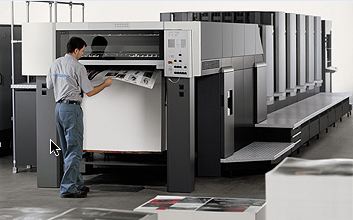 Extensive work on press and prepress - in optimisation of the plate production process, plate curves and press settings - gives a clear picture of the requirements and advantages of "standardised" working in print. The advantages are enormous, since any necessary visual optimisation can be carried out at proofing stage (given a good ISO standard proofer) rather than at press side.
Of course, no amount of colourmanagement will replace the skill needed to run a press well, but for the pressman, receiving properly optimised plates made from correct separations (i.e. made to a standard) is a great adjunct to skill. With a properly optimised press and with well made separations used to make good plates, running to numbers now becomes a way to match a proof properly and simply.
Click here for more about Neil's workflow at Christie's the fine art auctioneers
Organisations fogra, ugra, bvdm, ISO and ECI continue to carry out an immense amount of work on press characterisation. To the extent that they can now provide characterisation data and, from this, ECI make good quality icc profiles to cover a variety of press types, these are free to use and can be downloaded at the ECI web-site. Look for “eci offset profiles”, each package contains useful profiles and info on their use / origins. Lots more about prepress and the pressroom here
seminar reports
at Apple UK
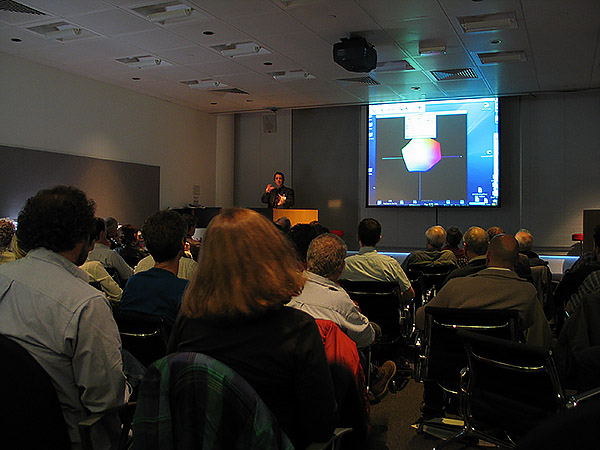
I presented a colourmanagement and imaging seminar with Steve Upton of Chromix USA - colour guru Steve is the inventor of the indispensable profile toolkit CHROMiX ColorThink and ColorThink PRO.
We all had a great day at Apple UK with Steve who was over in the UK from Seattle for a few days. Steve and I spoke about general colourmanagement issues and gave a tutorial on ColorThink PRO software
If you are interested in seminars, you may like to click here to register an interest in future events
we'll keep you posted.
extreme, New Orleans, a colormanagementgroup event
Neil Barstow took part in various presentations with Floran Sussl of Zipcon Consulting and Thomas Holm of Pixl, mainly on the subject of print standardisation according to ISO 12647
imaging seminars with Pixl
We had a great feedback from our 2 day colourmanagement and Imaging Seminar at Apple UK , featured alongside Neil Barstow were, among others, Richard West of Apple, Emma Lomax of Epson UK, Thomas Holm of Pixl Aps in Copenhagen and, esteemed author of Photoshop for Photographers, Martin Evening.
GATF, Arizona
Neil Barstow was invited to speak in a seminar entitled Advanced - Better Scanner Profiles and Customer Files at GATF in Arizona - also contributing to a Lab session on camera profiling with Derek Brown and Steve Upton - also a few very interesting panel sessions including one with Apple's own Colorsync guy John Zimmerer. It was a very interesting event with many vendors present providing the opportunity to meet many of the world's top colour guys as well as to address a big audience of mainly press and prepress guys. Yes, Standards Based Printing on press has taken hold in the supremely cost conscious USA too.